


Who’s Been Stealing Your Light? The Ghosts That Haunt Our Everyday Lives
October 28, 2026
Halloween is almost here. A time for ghosts, things that go bump in the night, and an entirely acceptable amount of chocolate and lollies.
But what about the ghosts that don’t live in haunted houses?
The ones that follow us to work, sit beside us while we’re scrolling through Instagram, and whisper in our ears when we’re trying something new.
You know the ones.
You’re not good enough.
You should be further along by now.
I know what they’re thinking.
What if you get it wrong?
Welcome to the world of our inner ghosts.
Meet the ghosts that steal our light
We all have our own cast of characters, but I suspect some of these will be familiar.
The Not Good Enough Ghost
This ghost has a remarkable ability to overlook everything you’ve done and focus exclusively on what you haven’t.
You could have years of experience, a string of achievements and a whole collection of things you’ve figured out along the way. Yet somehow, this ghost still finds a way to make you question whether you’re capable, whether you’re doing enough, or whether you’re really up to whatever comes next.
It’s particularly fond of comparing your behind-the-scenes reality with everyone else’s highlight reel.
The Should Ghost
This ghost has an endless to-do list and a very particular idea of how you ought to be living.
You should exercise more.
Be more patient.
Spend less time on your phone.
Have a bigger/cleaner house.
Be more productive.
Make more time for friends.
And somehow, you should be doing all of this while remaining calm, cheerful and well-rested.
Its favourite word is should. It treats expectations as obligations, as though every one of them is a rule you must follow. Its least favourite activity is acknowledging that you’re human.
The Mind-Reading Ghost
This ghost is remarkably good at knowing what other people think. Or, at least, what it imagines they think.
A friend takes ages to reply to a message? They’re annoyed with you.
People seem quiet? You must have said something wrong.
A colleague doesn’t comment on your idea? They obviously think it’s ridiculous.
This ghost has a very active imagination yet remarkably little evidence.
The What-Will-They-Think Ghost
A close cousin of the Mind-Reading Ghost, this one is less interested in guessing other people’s thoughts and more interested in preventing you from becoming the subject of them.
It can talk you out of sharing an idea, trying something new or saying what you really think.
What if you look silly?
What if nobody likes it?
What if you put yourself out there and it doesn’t work?
Its preferred strategy is to keep you safely tucked away where nobody can judge you.
Unfortunately, that’s also where a lot of possibility gets left behind.
The Overthinking Ghost
This one doesn’t shout. It whispers.
But what if…?
Have you considered…?
Maybe you should think about it a little longer.
It can turn a straightforward decision into an overnight rumination, examining every possible outcome without ever quite reaching a conclusion.
And the really clever thing? It convinces you that all this thinking must be productive.
Sound familiar?
Why do we keep listening?
Here’s the thing about these ghosts: they’re not always easy to recognise.
Our thoughts can feel like facts, especially when we’ve heard them repeatedly – maybe even for our whole lives. A familiar story about ourselves, other people or the world can become so ingrained that we stop questioning it.
We don’t just think I’m not good enough. We start behaving as though it’s true.
We don’t just wonder whether someone is upset with us. We react as though we know they are.
We don’t just think we should be doing more. We feel guilty when we’re not.
And so we turn down opportunities, seek reassurance, interpret silence as disapproval, or keep pushing ourselves to meet standards we’ve never stopped to question.
Sometimes these thoughts are trying to protect us from disappointment, embarrassment or rejection. They may have developed for understandable reasons.
But a thought that once served a purpose doesn’t necessarily deserve to drive the rest of our lives.
And just because a thought feels convincing, it doesn’t make it true.
Repeat after me, thoughts are not facts.
Let a Little Light In
A few years ago, I wrote about komorebi – the Japanese word for sunlight filtering through the leaves of a forest canopy.
I remember being on a bushwalk, caught up in my own thoughts, when I noticed the light falling across the plants. My attention shifted. I noticed the green of the leaves, the play of light and shadow, the beauty of the forest around me.
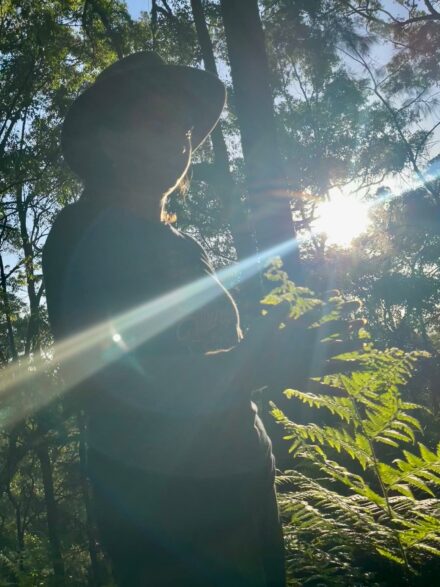
Nothing about my worries had necessarily changed. But for a moment, I was no longer completely absorbed in them. I was noticing something beyond the stories playing out in my head.
I wonder if we can do something similar with our inner world.
When the Not Good Enough Ghost appears, can we notice how quickly we dismiss what we’ve achieved? When the Mind-Reading Ghost starts telling us what someone else thinks, can we recognise that we’re making assumptions? When the Should Ghost starts reciting its endless list, can we pause and question whether those expectations are actually ours?
The light is awareness. It’s the moment we notice what’s happening inside us – the thoughts, judgements, fears and familiar stories that can so easily go unquestioned. It’s the moment they are illuminated so we can see them clearly.
Awareness doesn’t mean those thoughts are wrong. Sometimes they point to something we genuinely need to pay attention to. But more often than not, they’re old stories we’ve become accustomed to believing, and we haven’t stopped to consider whether they still serve us.
We don’t have to argue with every thought or replace it with a positive one. We can simply become curious. Is this true? Is it useful? Who would you be without that thought? Is there another way to look at this?
Like sunlight filtering through a forest canopy, awareness doesn’t make the shadows disappear. It helps illuminate them, so we can see them differently.
You Don't Have to Banish Every Ghost
We won’t get through life without self-doubt, worry or the occasional spectacular bout of overthinking. Nor should we expect ourselves to.
But we can learn to recognise our ghosts without automatically believing everything they tell us.
The next time one shows up, try noticing it. Give it a name. You don’t have to slay it, analyse it for hours or make it disappear. Just notice.
Sometimes, that little bit of awareness is enough to create room for another perspective, a possibility you hadn’t considered, or a different response.
You can observe a thought without handing it the keys to drive.
So, this Halloween, perhaps the invitation isn’t to banish your ghosts, but to get to know them – and let a little light in.
May your lollies be plentiful, your ghosts be friendly, and your inner critic give you the night off.

Cherie Pasion
Cherie Pasion is the founder of Connection Compass, a framework that helps people re-orient when life feels off and respond with clarity and steadiness. Her work draws on lived experience, behavioural science, systems thinking, and nature-based practice. Cherie has led award-winning behaviour change programs supporting thousands of people across Australia and is an internationally published author.Let's connect
Are we friends on social media, yet? Use the buttons below to connect.
Connection Compass acknowledges the Turrbal and Jagara people, Traditional Custodians of the Country on which we work, live and gather. We pause to honour this ancient Country, the people who have cared for it across generations, and the enduring connections between Country, community and spirit.
© Connection Compass 2024 - All rights reserved.